
Bayer Leverkusen is a club that carries a unique story from its earliest days. The team’s first kit was not ordered from a sports manufacturer but sewn by workers in the Bayer factory using leftover plant materials. Football fans who follow matches on XoilacTV often find such stories inspiring, reminding them that today’s giants sometimes began with the simplest resources.
From factory floors to football fields
The history of Bayer Leverkusen starts in 1904 when factory workers from the Bayer company founded a football team. At that time, industrial communities across Germany often built sports clubs to promote social life and unity. Football was seen as a way to escape the long hours of factory work and create a sense of belonging.
An introduction to Bayer Leverkusen’s football journey
Origins of Bayer Leverkusen in the industrial era
The workers who created the club were not wealthy athletes. They were ordinary employees from a chemical plant looking for a form of recreation. Football offered excitement and a chance to compete with nearby towns. The environment of German industrial towns helped spread the sport quickly, and Leverkusen became one of many worker-founded clubs.
Must Read: Website Cakhia update the match schedule, Champions League rankings
The birth of the first kit using factory scraps
Unlike professional teams with sponsors, the founding workers had no resources for sportswear. Instead, they collected fabric left behind in the Bayer factory and stitched together their first kits. These homemade uniforms may not have looked elegant, but they carried pride and represented determination. The fact that workers themselves produced the shirts symbolized how deeply the team was tied to the factory.
Colors that defined the club’s identity
From the beginning, the club embraced the colors red and black. Even though the first kits came from scraps, these colors became fixed symbols of Leverkusen. Over time they shaped the visual identity of the team. Red represented energy and strength, while black added contrast and intensity. To this day, supporters see the colors as a continuation of that humble but powerful start.
Rising in German football culture
Bayer Leverkusen’s rise from a small workers’ team to a recognized professional club did not happen overnight. It took decades of persistence, support from the Bayer company, and commitment from local fans. The story of the first kit is often used to show how the team grew step by step in the world of German football.
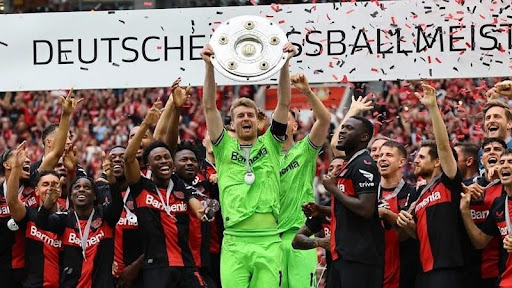
Bayer Leverkusen shines with outstanding accomplishments
Transition from a workers’ team to professional club
The early decades were challenging. The players balanced factory shifts with football matches, often training after long working days. As German football became more structured, Leverkusen gradually entered organized leagues. The move toward professionalism required investment, but the foundation laid by workers helped keep the team’s spirit alive.
Strong ties between industry and football
What made Leverkusen unique was the permanent connection to the Bayer company. Unlike other clubs that broke away from their roots, Leverkusen remained linked to the plant and its workforce. This connection influenced how the club was managed and financed. It also created a sense of loyalty between the team and the community, where many fans were also employees.
A symbol of collective effort and local pride
The story of factory workers sewing the first kit has been retold across generations. It highlights collective effort at a time when football was more about community than business. For local supporters, the kit represented pride in their town and workplace. It proved that even with limited means, passion and unity could build a football institution.
Legacy of the humble kit in modern Leverkusen
Today Bayer Leverkusen plays in the Bundesliga and competes regularly in European tournaments. The journey from homemade shirts to world-class jerseys is a reflection of football’s evolution. Yet the club has never forgotten the origins of that first kit and what it stood for.
From leftover materials to modern jersey designs
Modern Leverkusen players wear kits designed with advanced fabrics that control temperature and improve performance. Adidas and other suppliers have created sleek designs that are sold worldwide. Comparing these to the stitched scraps of 1904 shows how far the club has traveled. The story of the first kit remains a reminder of modest beginnings.
Inspiring underdog spirit in European football
Leverkusen has often been seen as an underdog in European competitions, competing with giants like Bayern Munich, Real Madrid, or Barcelona. The tale of the first kit embodies that underdog spirit. It shows how the club has always relied on effort and resilience rather than luxury. Fans embrace this identity when they support the team in tough matches, believing that history itself proves their strength.
What this story means for fans today
For modern supporters, the first kit is more than a curiosity from the past. It is a heritage that connects the present with the roots of the club. Fans wear replica shirts with pride, knowing the colors came from scraps sewn by factory hands. This sense of tradition makes every game feel like part of a much larger journey. The humble beginnings continue to inspire loyalty and passion across generations.
Conclusion
Bayer Leverkusen’s first kit, sewn from leftover factory materials, remains a story that defines the club. It reflects the values of resilience, unity, and community pride. From scraps of cloth to Bundesliga glory, the journey shows how humble origins can shape a football identity that still matters today.